Vending Businesses for Sale: Buy the Locations, Not the Machine Count
Buy the vending business whose locations will stay after the sale, whose machines you can keep running, and whose stops fit the hours you have. Judge every listing on those three things before you compare asking prices or how many machines come with it. This guide is for operators and first-time buyers looking at vending businesses for sale who want a quick way to tell a solid listing from a weak one.
By Mike Hoffmann, Founder · 8 min read
See routes for sale
On this page (9 sections)
- What kinds of vending businesses for sale will you find?
- Which kind of route should a first-time buyer pick?
- How do you know the locations will stay after the sale?
- What should you check on the machines in a route for sale?
- How do you work out what a vending business is worth?
- Should you buy a route or build one from location leads?
- What should you do in the first weeks after you buy?
- Your move this week
- Frequently asked questions
This is general information, not legal advice; check with your state and local agencies or an attorney.
What kinds of vending businesses for sale will you find?
Most listings fit one of a few shapes. They run from a small starter route to a full business with a vehicle and supplier accounts, and the shape tells you what to inspect first.
Sellers describe their routes in their own words, so one listing's "established route" can be another's "starter package." Sort each listing into one of the types below before you compare it with anything else.
| Listing type | What you get | Who it fits | Check first |
|---|---|---|---|
| Starter route | A few machines in a handful of locations | First-time and part-time buyers | Whether each location stays after the sale |
| Snack and drink route | A snack machine and a drink machine at each stop | Offices, plants, schools | Machine age and payment hardware |
| Snack only route | Snack machines without drink units | Smaller breakrooms | Product dates and stock rotation |
| Drink only route | Cold drink machines | Gyms, warehouses, outdoor sites | Refrigeration condition and service records |
| Combo machine route | Single machines that sell snacks and drinks | Tight spaces, lower-traffic sites | Capacity per stop and visit frequency |
| Micro market route | Open shelves, coolers and a self-checkout kiosk | Larger workplaces | Shrink history and the kiosk system |
| Smart cooler route | Locked coolers that open with a card or phone | Fresh food and drinks | Cost to own and connectivity |
| Full vending business | Locations, equipment, supplier accounts, possibly a vehicle and staff | Experienced operators scaling up | Every contract, account and asset |
Mixed routes combine several of these formats across different locations. They give you variety, but each format needs its own skills, suppliers and software, so count only the formats you can service well.
To see how listings are usually described, browse the locations and routes directory. It covers vending locations, routes and businesses for sale across the US, and new listings are added all the time.
Which kind of route should a first-time buyer pick?
For most first-time buyers, a small starter route close to home is the right first purchase. You learn restocking, cash handling, supplier ordering and location relationships without a large operation riding on every decision.
The catch with a small route is concentration. When there are only a few stops, losing one location takes a big share of the business with it. That makes the location checks in the next section even more important on a small route.
Match the format to what you already know:
- New to equipment: a snack only route has no refrigeration, so there's less to break and fewer cooling service calls.
- Already run snack machines: a snack and drink route in an area next to yours adds stops without adding new skills.
- Comfortable with tech and want fresh food: a micro market or smart cooler route, as long as you understand how shrink gets tracked.
- Experienced and ready to scale: a full business, if you have time to verify every contract and asset.
If micro markets and smart coolers are new to you, read the unattended retail guide before you inspect one. It explains the formats, the payment technology and how each one runs day to day.
How do you know the locations will stay after the sale?
Get a written agreement for every account, and talk to each site contact yourself before you sign anything. The machines can be replaced. The locations are what you're actually paying for.
A location without a contract can ask you to pull the machines the week after you close. Ask the seller for every agreement, check who signed it, and read how it handles a change of owner. Also note what commission each location is paid, because you'll be the one paying it from now on.
Visit every stop in person. Confirm the site manager knows a sale is happening and plans to keep a machine there. If the seller won't let you meet the contacts, treat that as a red flag.
The vending routes for sale page lists current routes and the checks to run before you buy one. Use it as a checklist when you go through a seller's paperwork.
What should you check on the machines in a route for sale?
Check the payment hardware, the refrigeration, whether each machine is connected, and how old it is. Older machines that don't take cards or phones turn away customers who don't carry cash.
Each format has its own weak spot:
- Drink machines: ask for service records. A failing compressor is an expensive surprise to find after closing.
- Snack machines: look at the product dates. A seller who hasn't rotated stock leaves you old inventory and a reputation to repair.
- Micro markets: ask how the seller tracks missing product, which kiosk system is installed, and whether its data transfers to you.
- Smart coolers: confirm the coolers stay connected, since the lock and the record of what was taken both depend on it.
Before you take on smart coolers, run them through the smart cooler cost comparison. It shows what a cooler costs to own over one to five years, which tells you whether the ones in the listing are an asset or a bill you'll be paying. Coolers with screens can also earn ad payouts through VendMedia.
If a machine needs replacing, keep in mind that VendHub sells new machines only, never used or refurbished. Price the replacements into your offer before you make it.
How do you work out what a vending business is worth?
Value the business one location at a time. Use the seller's sales records for each location, then subtract what it really costs you to serve that stop.
Ask for sales records broken out by location, not one total for the whole route. One strong account can hide several weak ones in a combined number. Run each stop through the location profit calculator, which accounts for rent, spoilage, commission, fees and your time.
Then map the work. Plot every stop, count the drive time between them, and ask how often each one gets serviced now. A route spread across a wide area with frequent restocking can eat your week even if the sales look fine.
If the machines are connected, ask whether their sales history moves with them after the sale. History you can check is worth more than a seller's summary.
Should you buy a route or build one from location leads?
Buy a route if you want placements now and can live with the equipment that comes with them. Build from location leads if you'd rather choose your own machines and locations and can spend the time winning each placement.
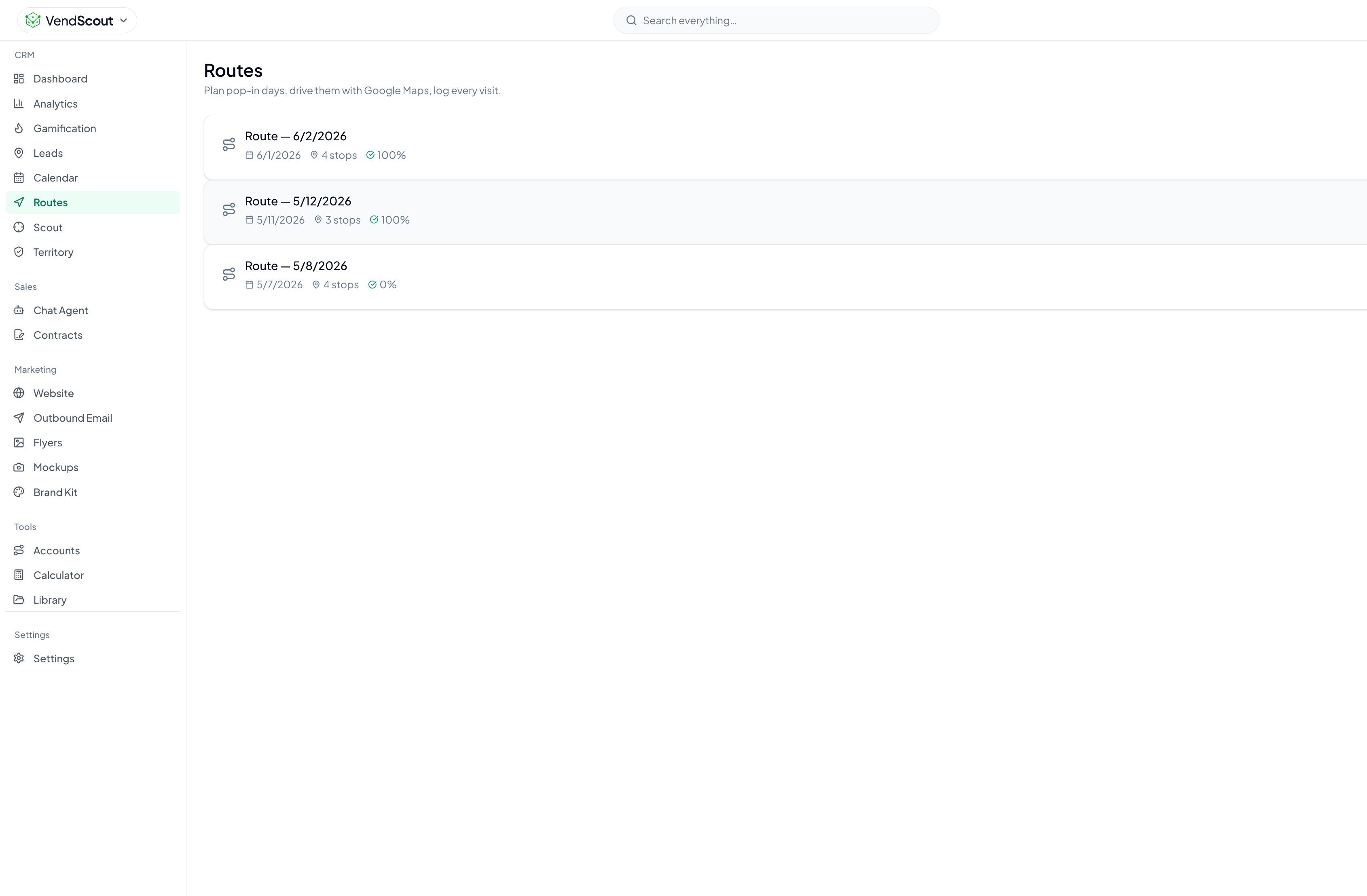
Buying gets you running faster, but you take on the seller's machines, habits and agreements. Building takes longer, but every location is one you picked and every machine is one you chose. Plenty of operators do both: they buy a small route and fill the gaps with new placements.
VendScout gives you ranked location leads from Google Maps, plus contracts to sign once a location says yes. Grow my route works for any US ZIP code and keeps every lead in one pipeline, so you can see how many prospects exist near a route before you buy it.
What should you do in the first weeks after you buy?
Get every machine reporting into one place. That way you can see which locations carry the route and which ones only cost you drive time.
VendLytics connects all your machine data and tracks each machine's sales and revenue in one view. It also produces a Location Statement and a Revenue Share report for each location, which gives you the commission numbers to send your locations. Check the integrations page to see which machine systems it connects to.
Restocking is the next job. Pantry puts national wholesale suppliers under one login and one cart. VendHub members get discounted member pricing on equipment and supplies, which adds up over time, especially as you add machines.
Run my operation keeps everything under one VendHub login for you and your team, so a new route doesn't mean a stack of separate accounts.
Your move this week
- Sign up for VendHub Drops to get free email alerts when a vending route goes up for sale or a new location lead appears near your ZIP.
- Pick two listings and ask each seller for the location agreements, sales records by location and a list of machines with their ages.
- Run every location from those listings through the location profit calculator and drop the stops that don't hold up.
- Drive the route that's left. Visit each stop, meet the site contact and look at the payment hardware and refrigeration yourself.
- If no listing survives, try the free vending location finder: enter a ZIP code and business type and get five real nearby businesses to pitch.
Frequently asked questions
Where can I find vending routes listed for sale?
Start with VendHub's vending routes for sale page, which lists routes and the checks to run before buying. The locations and routes directory covers routes and listings across the US, and the vending leads and routes page shows location leads and routes for sale together, so you can compare buying with building.
How do I sell my vending route?
List it on the sell your vending route page. Listing is free, and the listing stays private until you pick a buyer. Have your location agreements, machine details, sales records by location and service schedule ready, because serious buyers will ask for all of them before they make an offer.
Do routes for sale usually include the machines?
It depends on the seller, so get it in writing. Some sales include every machine, while others have leased equipment or leave some units behind. If you need to replace or add machines, VendHub sells new equipment, and the see it in my space tool shows a site manager the new machine in their room.
Can I finance new machines for a route I'm building?
VendHub doesn't lend directly. Members get equipment financing inside the platform through VendHub's partner, APPROVE. Talk to the partner about terms before you commit to an offer or a placement, so you know what you can buy as you build out new locations or replace worn machines from a purchased route.
Do I need an attorney to buy a vending route?
Buying a route means taking over location agreements and assets, and the rules vary by state. This is general information, not legal advice; check with your state and local agencies or an attorney. Have someone qualified review the purchase agreement and every location contract before you sign anything.
What does VendHub cost for a new route owner?
VendHub has a membership, plus VendLytics priced per machine. Current details are on the pricing page. Before you decide, the platform walkthrough gives a screen-by-screen tour of the real app, so you can judge whether it fits the route you're buying and the number of machines you plan to run.
Keep reading
 Used Vending Machines for Sale: Buy Used Only When You Can Watch It Run
 How Much Are Vending Machines? Let the Location Set Your Budget Before the Catalog Does
 Vending Machine License: Why No Single Office Covers It, and the Paperwork Each Placement Needs
 Vending Machine Rental, Leasing and Financing: Match the Payment to How Sure You Are About the Location